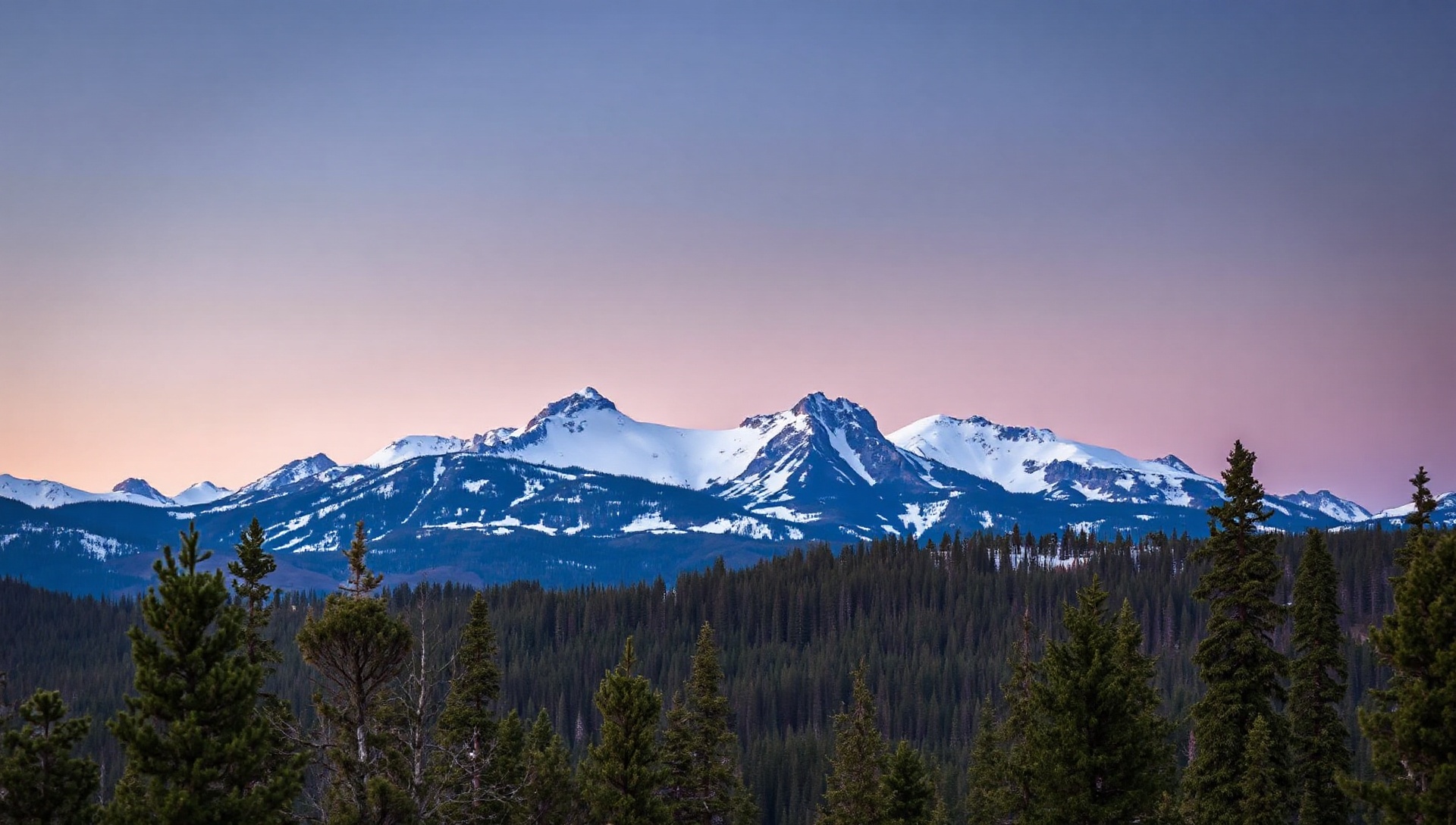
Rocky Mountain National Park gets the attention, but the overlooks that fill Colorado elopement galleries are mostly National Forest: Sapphire Point, Loveland Pass, Guanella Pass, the lakes below the Indian Peaks. The Forest Service regulates these places with a lighter hand than the Park Service, and for a small ceremony the rules often amount to “behave like any other visitor.” This page explains the thresholds the Forest Service uses, where they stop applying, and how they play out at the spots couples ask about most.
The Forest Service framework
The Arapaho and Roosevelt National Forests, which cover the Front Range from the Wyoming line to Mount Blue Sky, publish the clearest statement of the rules, and the other Colorado forests apply the same national regulations. The questions to ask about your ceremony are:
Is it group use? An event becomes group use when 75 or more people take part as participants or spectators. Group use requires a special use permit, full stop.
Is it commercial? Commercial use means charging an entry or participation fee, or an activity whose primary purpose is selling a good or service. Your wedding is not commercial. Your photographer’s business might be, which is why professional photographers hold their own permits on some forests; ask yours.
Where is it? Congressionally designated areas such as Wilderness, the Arapaho National Recreation Area and the Cache la Poudre corridor may require a permit at any size, and group size is restricted in Wilderness. The Arapaho and Roosevelt specifically state that events and weddings are not allowed along Highway 5 or at developed sites on Mount Blue Sky.
Does it risk resource damage? Events involving props of any kind require a permit. The forest’s own words: props typically require a permit. That means chairs for guests, an arch, a table for the license, a tent. Hay bales must be certified weed free. Even without props, a large group at a fragile alpine site may be asked to get a permit.
If your answers are under 75 people, not commercial, outside a protected area and no props, the Forest Service does not require a permit for you to stand on public land and marry. The Arapaho and Roosevelt supervisor’s office (970-295-6600) will tell you in a minute whether your spot has a wrinkle.
Special use permits, if you need one
A special use permit is a formal authorization with conditions, usually an insurance requirement and a fee. The Arapaho and Roosevelt say to allow six months to a year. Start with the ranger district that manages your site, describe the date, place, headcount and equipment, and ask which form to use. Planners in our directory handle this routinely.
Leave No Trace is the real rule
The Forest Service’s light touch depends on couples not leaving a mark. The Leave No Trace principles are the standard rangers apply when they decide whether a ceremony caused resource damage. In wedding terms:
- Stay on durable surfaces: rock, gravel, established trail. Do not stand in a wildflower meadow for the photo.
- Pack out everything, including petals, ribbon and the champagne cork.
- Leave what you find. No stacking rocks, carving initials or picking flowers for the bouquet.
- Respect wildlife and other visitors. You do not have exclusive use of anything.
- No smoke bombs, no sparklers, no fireworks. Fire restrictions in Colorado are frequent and the fines are real.
- Keep dogs leashed where required.
A ceremony that follows these is one the Forest Service wants to allow.
Sapphire Point Overlook, Summit County
Sapphire Point sits on Swan Mountain Road between Breckenridge and Keystone at 9,500 feet, looking over Dillon Reservoir to the Gore Range. Unlike most forest overlooks, it is a reservable site. Recreation.gov lists it as a non exclusive day use area that can be reserved in three hour blocks for private gatherings of up to 30 people, and from June 14, 2026 all reservations use the new north overlook. Chairs, tents, food and drink, and anything staked into the ground are not allowed; reserved events get two parking spaces, and Recreation.gov notes that commercial use at the site is prohibited. The listing shows a fee of about $120 to $142 per block. The Dillon Ranger District is at 970-468-5400. Our Sapphire Point guide covers every rule, and vendors who work here weekly are in our Summit County region.
Loveland Pass
Loveland Pass on Highway 6 tops out at 11,990 feet on the Continental Divide, with the Clear Creek Ranger District of the Arapaho National Forest on the east side and the Dillon Ranger District of the White River National Forest on the west. On the Clear Creek side the general rules above apply: a small group with no props is ordinary use. On the Dillon side, the district’s statement that Sapphire Point is its only designated wedding site means you should call 970-468-5400 before planning a ceremony there rather than assume. Either way, park only in the designated pullouts, expect wind at any hour, and know that the pass closes in heavy snow. We could not find a Loveland Pass specific wedding page on fs.usda.gov; the ranger districts are the authority.
Brainard Lake Recreation Area
Brainard Lake, west of Ward in the Boulder Ranger District, is the classic Indian Peaks foreground. Two things govern a ceremony there. First, a timed entry reservation is required to park inside the recreation area during the summer season, roughly mid June to mid October, purchased on Recreation.gov; everyone arriving by car, including guests, needs one. You can skip the reservation by parking at the Gateway Trailhead and walking or biking in for a $10 day use fee, and in summer 2026 a pilot shuttle ran on weekends for $5. Second, the lakes beyond the trailheads (Long Lake, Lake Isabelle, Mitchell Lake) are inside the Indian Peaks Wilderness, where group size is restricted and a ceremony may need a permit. Brainard Lake itself is outside the Wilderness. Snow lingers into July. Our Boulder guide covers the area.
Guanella Pass
Guanella Pass connects Georgetown and Grant, with the Clear Creek Ranger District on the north side and the Pike National Forest’s South Platte Ranger District on the south. A standing area order through 2028 restricts camping, fires, and being in the area between 10 p.m. and 6 a.m., and parking is allowed only in designated sites and at the summit, because Guanella Pass Road is a county road. The Guanella Pass and Bierstadt trailheads carry a group limit of 15 people, and the Mount Evans Wilderness, which begins near the summit, requires a free self issued permit. A sunrise ceremony for a handful of people in the willows below the summit lot is ordinary use; a group of twenty with chairs is not. The pass closes to through traffic in winter. Vendors are in our Denver and Foothills region.
Independence Pass
Independence Pass on Highway 82 reaches 12,095 feet between Aspen and Twin Lakes, with the White River National Forest on the Aspen side and the San Isabel National Forest on the east. The summit area is a developed site with a paved trail to the overlook. It is open only from about Memorial Day to mid October, weather dependent, and there is no reservable ceremony site. The Aspen Sopris Ranger District (970-963-2266) is the office to ask about anything beyond a few people standing at the overlook. For a reservable site in the same valley, see our Maroon Bells permit page.
BLM land
The Bureau of Land Management manages much of western Colorado’s lower country, from the desert near Grand Junction to the sage hills around Ridgway. BLM field offices issue special recreation permits for commercial, competitive and organized group use; a small private ceremony generally falls outside those categories. Rules vary by field office and designated area, so ask the office that manages your spot through blm.gov/colorado.
Two regional guides apply these rules in practice: Crested Butte on the Gunnison National Forest and Ouray on the Uncompahgre.
Before you go
Confirm the ranger district, check fire restrictions the week of, and read the marriage license page so the legal side is done before you drive up. For someone who already knows the lot, the light and the ranger, start with the photographers and officiants in your region.
Related reading: our Vail elopement guide and our Durango and Pagosa Springs elopement guide.